
Aug 26, 2026
Dengue, Malaria and Typhoid: How to Tell the Difference
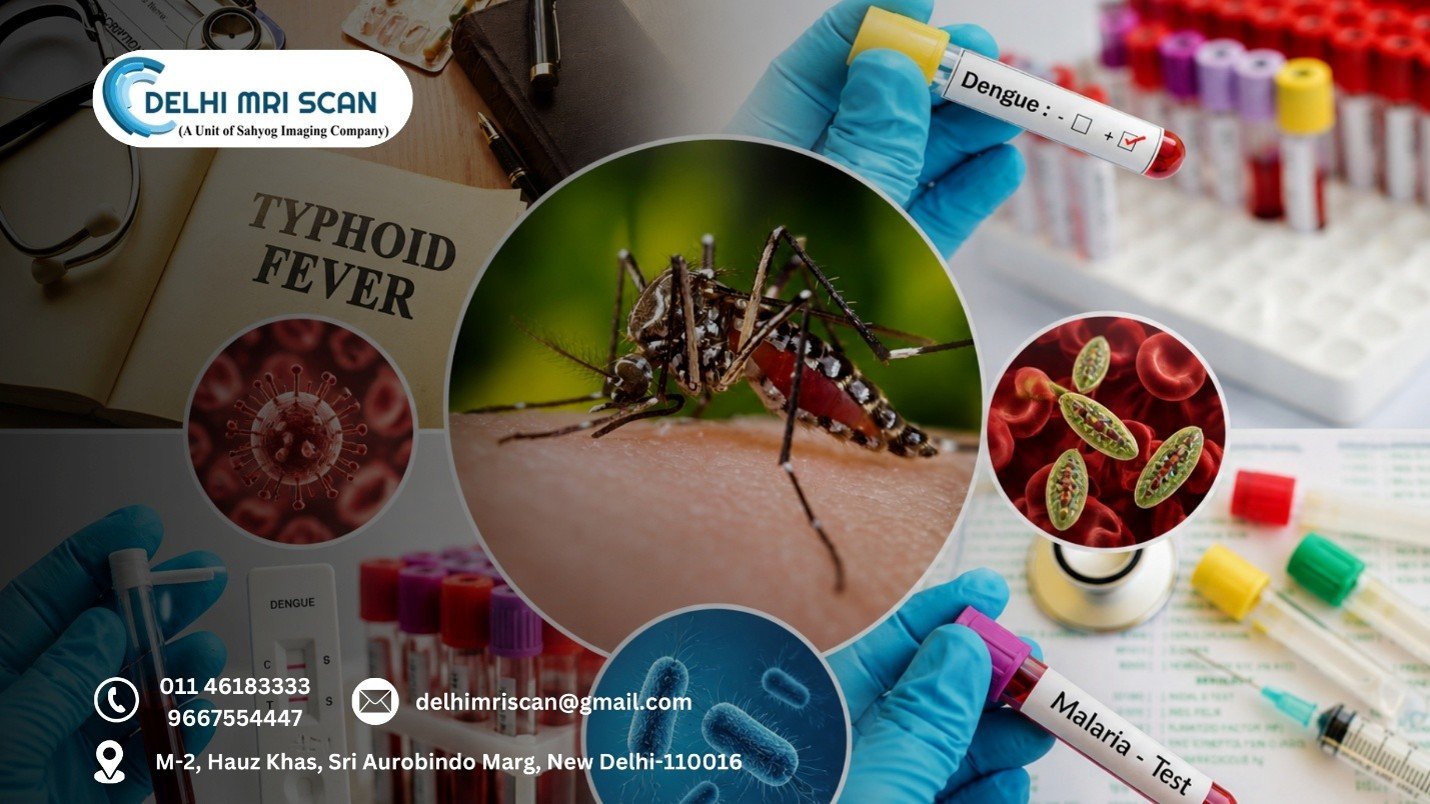
Every year, thousands of people in Delhi and across India develop fever during and after the monsoon season. The first thought in most minds is almost always the same, is it dengue? Could it be malaria? Or could it be typhoid?
At Delhi MRI Scan, one of Delhi's most trusted diagnostic centres, we see this confusion every single day. Patients arrive worried, often having already self-diagnosed based on what they read online or heard from neighbours. Some have even started treatment for dengue when they actually had typhoid, or vice versa.
This article is written to cut through that confusion. In plain and simple language with no medical jargon and no complicated terminology, we explain what makes dengue, malaria, and typhoid different from each other, what tests are actually needed to diagnose each one, and why getting the right test at the right time makes all the difference.
Why Do These Three Diseases Get Confused?
The reason dengue, malaria, and typhoid are so frequently confused is simple. They all start the same way.
All three can cause fever, headache, body aches, weakness, nausea, and loss of appetite. During the early days of illness, even experienced doctors cannot reliably tell them apart based on symptoms alone. This is not a failure of medicine. It is simply the reality of how these infections behave in the human body.
This symptom overlap is exactly why laboratory testing is not optional. It is essential. Without the right diagnostic test, no one can be sure which infection they are actually dealing with. And each infection requires a completely different treatment approach.
The Most Important Difference: What Causes Each Disease
Before anything else, it helps to understand that these three illnesses are caused by entirely different organisms.
Dengue is a viral infection. It is caused by the dengue virus and is spread through the bite of an infected Aedes mosquito. You cannot catch dengue from another person directly, only through a mosquito that has fed on an infected individual.
Malaria is a parasitic infection. It is caused by Plasmodium parasites and is also spread through mosquito bites, though a different type of mosquito than dengue. Malaria can become serious quickly if not diagnosed and treated promptly.
Typhoid is a bacterial infection. It is caused by Salmonella Typhi bacteria and has nothing to do with mosquitoes. Typhoid spreads through contaminated food and water. This makes it fundamentally different in how it enters the body.
Because these three conditions are caused by three completely different types of organisms, a virus, a parasite, and bacteria, the tests used to detect them are also completely different. A dengue test cannot detect malaria. A malaria test cannot diagnose typhoid. Each requires its own specific diagnostic approach.
-
Dengue: Understanding the Symptoms and Tests
Dengue typically begins suddenly with a high fever. Along with the fever, patients often experience severe headache, pain behind the eyes, muscle and joint pain, nausea, and sometimes a rash. The joint pain in dengue can be intense. This is why dengue is sometimes called breakbone fever.
However, these symptoms overlap significantly with other illnesses. This is why dengue must always be confirmed through proper laboratory testing.
- The NS1 Antigen Test is one of the most commonly used tests for dengue. NS1 is a protein produced by the dengue virus during the early days of infection. This test is most useful during the first week of symptoms when the virus is actively circulating in the bloodstream. A positive NS1 result strongly supports a dengue diagnosis, but a negative result does not always rule it out. Your doctor may recommend additional tests depending on the situation.
- Dengue RT-PCR Testing detects the genetic material of the dengue virus directly and is highly accurate during the early stage of illness. It is one of the most reliable ways to confirm an active dengue infection.
- Dengue IgM Antibody Test becomes useful after the first week of illness, when the body has started producing antibodies in response to the infection. Timing matters here. Testing too early may give a negative result even in a patient who truly has dengue.
- Complete Blood Count (CBC) and Platelet Count are commonly done alongside dengue-specific tests. A falling platelet count is often associated with dengue, but here is something critically important that many patients do not know: a low platelet count alone does not confirm dengue. Many other conditions can lower platelets. Dengue can only be confirmed with specific dengue tests. A CBC alone is not enough.
-
Malaria: Understanding the Symptoms and Tests
-
Malaria symptoms can include fever, chills, shivering, sweating, headache, body aches, weakness, and nausea. One pattern classically associated with malaria is fever that comes and goes in cycles, the patient feels burning hot during a fever episode, sweats heavily, and may feel relatively better before the fever returns again. However, this pattern is not always present, and malaria should not be diagnosed or ruled out based on fever pattern alone.
The most important thing to know about malaria is that it must be diagnosed quickly. Delay in malaria diagnosis and treatment can lead to serious complications, especially with certain types of malaria.
- Peripheral Blood Smear Microscopy is the gold standard test for malaria. A trained laboratory technician examines a drop of blood under a microscope to look for malaria parasites directly. This test can not only confirm the presence of malaria but also identify which species of parasite is causing the infection. This is important because different types of malaria require different treatments.
- This is one of the clearest differences between malaria and dengue diagnosis. For malaria, the test looks directly for the parasite under a microscope. For dengue, the test looks for viral proteins, genetic material, or antibodies rather than a parasite.
- Rapid Diagnostic Tests (RDTs) for Malaria can detect certain malaria parasite components quickly and are widely used, especially when microscopy is not immediately available. However, RDTs have limitations, and microscopy is still considered more reliable for accurate diagnosis.
- PCR Testing for Malaria can identify parasites with high sensitivity and help determine the exact species. It is particularly useful in complex or difficult-to-diagnose cases.
One important thing to know: a single negative blood smear does not always completely rule out malaria. If a doctor still suspects malaria after a negative result, they may recommend repeating the test. Parasite levels in the blood can be very low during early infection.
-
Typhoid: Understanding the Symptoms and Tests
Typhoid often develops more slowly than dengue or malaria. The fever tends to rise gradually over several days rather than starting suddenly. Other symptoms include persistent fatigue, headache, loss of appetite, abdominal discomfort, constipation or diarrhoea, and nausea.
Because typhoid spreads through contaminated food and water, not mosquitoes, your exposure history matters. If you have been drinking unfiltered water, eating street food, or travelling to areas with poor sanitation, typhoid becomes a more likely consideration regardless of mosquito exposure.
- Blood Culture is the most important and reliable test for diagnosing acute typhoid. In this test, a blood sample is placed in a special medium that encourages bacterial growth. If Salmonella Typhi is present in the blood, it will grow in the culture and be identified. Blood culture is particularly sensitive during the first week of fever when bacteria are most abundant in the bloodstream. It is the preferred diagnostic method because it provides direct confirmation of the bacterial infection.
- Stool Culture can also be used in typhoid diagnosis. It is generally less sensitive than blood culture during the early stage of illness but can be useful in certain situations.
- The Widal Test is widely known in India and is often the first test people think of for typhoid. However, it has significant limitations that every patient should understand. The Widal test measures antibody levels in the blood, but antibodies can remain elevated for months or even years after a past infection or vaccination. This means the test can give a positive result even when no current infection exists. Conversely, it can give a misleading result in the early days of illness when antibodies have not yet developed. For these reasons, blood culture remains the preferred method, and a Widal result should never be interpreted without a doctor's guidance.
Can You Have More Than One Infection at the Same Time?
Yes, it is possible, though not common. A person can in theory have more than one infection simultaneously. This is another reason why a positive test result for one condition does not automatically explain every symptom. If symptoms persist or do not fit neatly with one diagnosis, doctors may order additional tests to rule out other causes.
This is also why self-diagnosis is risky. Finding one abnormal result and assuming it explains everything can lead to the wrong conclusion, and potentially the wrong treatment.
Warning Signs That Need Urgent Medical Attention
Regardless of whether you suspect dengue, malaria, or typhoid, the following symptoms should prompt an immediate visit to a doctor or hospital without delay.
Severe weakness or drowsiness that is rapidly worsening, difficulty breathing, persistent vomiting that prevents you from keeping fluids down, severe abdominal pain, any unusual bleeding, confusion or disorientation, fainting, signs of dehydration, or symptoms that continue to worsen despite initial treatment, all of these are red flags that require urgent evaluation.
Malaria in particular can deteriorate rapidly, and severe dengue also requires immediate medical attention. Do not wait in the hope that symptoms will improve on their own when these warning signs are present.
Conclusion: The Right Diagnosis Changes Everything, Delhi MRI Scan
Dengue, malaria, and typhoid are three different infections with three different causes, three different diagnostic tests, and three different treatment approaches. Symptoms alone cannot tell them apart. A platelet count alone cannot confirm dengue. A Widal test alone cannot confirm typhoid. And no amount of online research can replace a proper laboratory test and a doctor's clinical assessment.
At Delhi MRI Scan, a trusted diagnostic centre in Delhi, we believe that the right test at the right time is not just good medical practice, it is the single most important step a patient can take toward getting better faster.
If you or someone you love has a fever that is persistent, worsening, or worrying, do not wait for symptoms to make the diagnosis. Do not rely on assumptions. Come in, get tested properly, consult your doctor, and get the answers you actually need.
Related post

Dec 15, 2025
Tests Every Woman Should Consider After 30

Dec 02, 2025
